



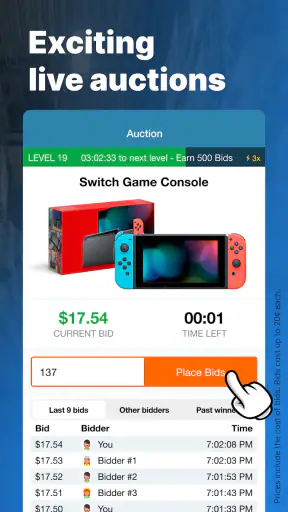

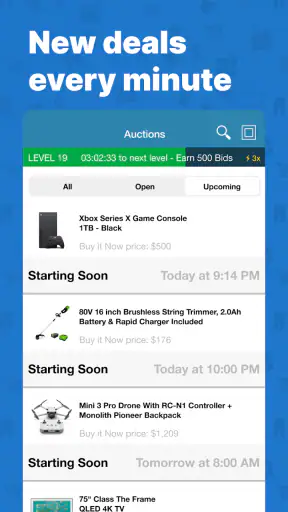


I approached DealDash - Bid & Save Auctions as a shopping app for people who enjoy the process of watching live auctions, deciding when to bid, and looking for savings rather than simply adding an item to a cart. That distinction matters. This is not just another product-search tool: its appeal comes from the auction format and the possibility of finding an attractive deal while the event is active.
My first impression is that DealDash is easiest to understand when you treat it as a more deliberate alternative to ordinary online shopping. The developer is DealDash.com, the app is free to install, and its Everyone age rating makes it broadly accessible. It has also built a sizeable audience, with over five million installs and an average rating of 4.6 from around sixty-five thousand ratings. Those figures suggest that the concept has reached well beyond a small group of bargain hunters.
What I like most is that the app gives shopping a sense of occasion. Instead of searching, comparing, and checking out in a few seconds, I can follow an auction and make a choice under changing conditions. That can be entertaining, but it also means the app rewards patience and attention more than impulse. If you want a guaranteed price and a predictable checkout, a conventional retailer will usually feel simpler.
How DealDash feels during real shopping sessions
Speed expectations when browsing and bidding
DealDash is at its best when I open it with a clear purpose rather than casually wandering through an endless catalog. The live-auction approach naturally asks me to spend more time observing an item before deciding whether it is worth pursuing. A quick visit can work for checking what is active, but the real value comes from watching how an auction develops and resisting the temptation to react to every change.
That makes perceived speed slightly different from the experience of a normal shopping app. A standard marketplace feels fast because I can search for an item, compare listings, and place an order. Here, the app’s pace is tied to live activity. Even if screens open quickly, I still need to wait for the right opportunity and make decisions at the right moment. In my view, that is part of the design rather than a flaw, although shoppers accustomed to instant purchases may initially find it slower.
The current version, 7.13.16, is intended for devices running Android 7.0 or later. That gives the app a reasonably broad Android audience, including phones that are not especially new. Still, operating-system compatibility alone does not guarantee an equally smooth experience on every handset. A modern phone with a stable connection should be better suited to live activity than an older device already struggling with several demanding apps.
One useful habit is to decide my spending limit before entering an auction. I also compare the item with its normal price elsewhere before getting emotionally invested. That simple preparation improves the experience because it turns the app from a stream of tempting events into a controlled shopping tool. The auction format can make a small price movement feel urgent, so having a personal ceiling is more useful than relying on excitement in the moment.
What happens during heavier use
The most demanding moments are likely to be periods when I move quickly between active auctions, monitor several possibilities, and keep the app open while making decisions. This is where a live-shopping app has a different workload from a basic product browser. The phone needs to keep the current auction context visible while I react, and the experience depends more heavily on staying attentive than on simply loading a product page.
I would not use DealDash as a background shopping companion while doing something that requires concentration. The auction format makes divided attention risky: I could miss a change, lose track of the item I was following, or make a decision without checking the total value carefully. For me, the better workflow is to choose a short shopping session, focus on one or two realistic targets, and leave when none of them make sense.
This also affects battery expectations. I would expect any app used for extended live activity to be more demanding than a quick search-and-checkout visit, although the exact effect will vary by phone, screen brightness, connection quality, and how long the session lasts. I would avoid starting a long auction session with a nearly empty battery, especially when away from a charger. That is practical advice rather than a claim about a fixed battery drain.
Another trade-off appears when a household shares a slower or older phone. DealDash may still install on a compatible device, but the auction experience is more sensitive to general device condition than a simple shopping list. If the phone frequently pauses, closes apps, or struggles with ordinary browsing, I would not choose it as my main auction device. A newer, well-maintained phone is more likely to make the timing feel comfortable.
Reliability and recovering from interruptions
Reliability matters more here than it does in a static catalog because the shopping experience is time-sensitive. A brief interruption while reading a product description is inconvenient; an interruption during a live auction can make me lose context and question whether I should continue. For that reason, I prefer using the app on a dependable connection and avoiding situations where I know the signal may change frequently.
My practical recovery routine is straightforward. If the app stops responding or I leave it accidentally, I reopen it, return to the relevant auction area, and verify the current state before doing anything else. I would not assume that a screen left open still reflects the situation after a network change or a long pause. Checking first prevents a rushed decision based on stale information.
The same caution applies when switching between Wi-Fi and mobile data. A connection handoff can make any live service feel less predictable, so I would rather pause my activity and recheck the auction than continue immediately. DealDash’s format makes this especially important because the value of an action depends on what is happening at that moment, not just on the item page itself.
I also recommend keeping the app updated through the normal app-store process. The listed release is 7.13.16, and staying current is a sensible way to benefit from the developer’s ongoing maintenance without treating an update as a guarantee of perfect performance. If a problem appears only after switching networks or returning from another app, I would first retry with a stable connection before deciding that the service itself is unreliable.
Device limits and sensible expectations
The Android requirement of 7.0 or later means owners of very old phones may be excluded, while many everyday Android users should meet the basic software requirement. Even among compatible devices, performance can differ significantly. Available storage, memory pressure, background activity, and the age of the phone all affect how quickly a shopping app feels in practice.
I would be particularly careful with devices that regularly reload apps when I switch away from them. Live auctions benefit from continuity, and frequent reloads can make it harder to return to the exact context I was following. Closing unrelated apps before a focused session may help an older phone, not because DealDash has a published resource requirement, but because reducing general pressure is a sensible way to improve any live mobile experience.
Tablet owners may enjoy the extra screen space when comparing details or keeping an auction visible, but I would still judge the app by how comfortable the interface feels on the particular device. A larger display is useful only if the layout remains easy to scan. On a small phone, I would keep my sessions more focused and avoid trying to track too many opportunities at once.
For iPhone users, the important practical question is whether their device can run the current version offered through the relevant store. I would check that directly before planning a purchase session. The app’s core appeal does not change between platforms, but the smoothness of a live experience always depends on the specific phone, its software, and the quality of the connection being used.
Everyday use: a realistic bargain-hunting routine
Imagine I am looking for a practical household item but do not need it immediately. I could open DealDash, review the active opportunities, and select only an item whose value I already understand. I would then decide how much I am willing to spend, watch the auction without jumping into every tempting listing, and stop if the total no longer looks attractive. This is a much healthier routine than opening the app with no limit and treating every auction as a must-win opportunity.
The promise of always-free shipping is appealing in that scenario because delivery cost can otherwise erase a small saving. Even so, I would evaluate the complete purchase conditions and the item’s usefulness rather than judging the deal from the headline alone. Free shipping makes comparison easier, but it does not automatically make an unnecessary item a good purchase.
For someone who enjoys bargain hunting, the live format can turn an ordinary shopping break into a focused activity. I can see the appeal for people who like timing, patience, and the possibility of finding a lower-cost purchase. On the other hand, a person who dislikes uncertainty may find the same process tiring. The app is better for flexible needs than urgent ones: if I need a replacement today, I would usually choose a retailer with a fixed price and a clear delivery estimate.
Where it beats ordinary shopping apps, and where it does not
Compared with a standard marketplace, DealDash offers a more interactive way to shop. Conventional apps are stronger when I already know the exact product, want to compare many sellers, or need a predictable transaction. Their search-and-checkout flow removes most of the waiting and decision pressure. DealDash is more distinctive when I am open to browsing live opportunities and willing to trade certainty for the possibility of a better deal.
Compared with a traditional auction website, the mobile experience is more convenient for checking activity during the day, but convenience can also encourage overuse. I might open the app more often simply because it is always available. That is why I think the best users are those who set boundaries: choose a target, define a limit, and treat a missed auction as a normal outcome rather than a reason to chase the next one.
The shipping promise is another practical advantage when comparing final value, because delivery charges can make two apparently similar purchases very different. However, I would still compare the item itself, the condition, and the overall terms with alternatives before bidding. The app can improve the discovery process, but it should not replace ordinary price research.
Who should use it and who should skip it
I would recommend DealDash to a patient bargain hunter who enjoys live auctions, has flexible shopping needs, and is comfortable making decisions within a changing event. It is also a reasonable choice for someone who likes turning shopping into a small game of timing and restraint, provided the person treats the budget as more important than winning.
I would be less likely to recommend it to anyone who finds auctions stressful, needs a guaranteed item at a fixed price, or tends to make purchases when feeling competitive. The format can be engaging, but engagement is not the same as value. If I cannot explain why an item is worth buying before the auction becomes exciting, I should probably leave it alone.
Parents should also remember that an Everyone rating describes broad content suitability, not personal spending judgment. A shopping app can be appropriate for general audiences while still requiring supervision around purchases and budgets. I would explain the auction process clearly to younger users and avoid allowing unsupervised bidding or buying decisions.
My performance verdict
After considering the way DealDash fits into real shopping routines, I see its performance as closely tied to the quality of the device and connection rather than to raw loading speed alone. On a compatible, well-maintained phone with a stable network, the live-auction concept should feel most natural when I use it in short, focused sessions. Older or overloaded devices are less suitable for an activity where keeping context matters.
The app’s strongest performance quality is practical responsiveness in the broader sense: it gives me a focused place to follow live opportunities instead of making me search through a huge conventional catalog. Its main weakness is that the same live structure demands attention and makes interruptions more frustrating. That is a trade-off I would accept for occasional bargain hunting, but not for every shopping need.
DealDash is free, supported on Android 7.0 and later, and has been available since January 15, 2014. Its long presence and broad adoption give it a level of familiarity that newer auction apps may not have, while the current version shows that it remains maintained. Still, those facts should support a decision, not replace one: the right question is whether live bidding suits the way I shop.
My final recommendation is conditional but positive. I would install it for flexible purchases, compare values before bidding, keep sessions focused, and use a firm personal limit. I would not use it as my only shopping app or as a substitute for urgent, fixed-price buying. DealDash works best when I treat the auction as a tool for disciplined bargain hunting, not as a contest I have to win.


